Anyone who knows me, knows I love to jump on a bandwagon. When the pilot on my flight back into New York last weekend congratulated the Knicks, I cheered with the rest like I was one of them. In reality, the sound of sneakers on wood triggers me and I haven’t been to a basketball game since when Shaq played for L.S.U.
So while I’ve managed to limit my blog posts to once a quarter to make room for more prolific writers, I decided to take on the random blogwagon. In looking at randomness in gaming as a topic, the most natural place to look, according to more knowledgeable friends, was Necropraxis: a blogger who was proficient for many years and put out not only great theory but also rich gameable content.
One of the things that jumped out at me in reading the Necropraxis blog is that he wasn’t only using dice to determine the outcome of an action, but using different dice to actually prompt direction of the story and content.
In D&D, the dice might be used to adjudicate a situation. For instance, during combat when a player character (PC) attacks a non-player character (NPC), say a dragon, then you would roll the dice to see if you hit or not and then, if you meet or beat the target number, you roll other dice to see how much damage you did. That dictates the success of the attack and, on a hit, its efficacy.
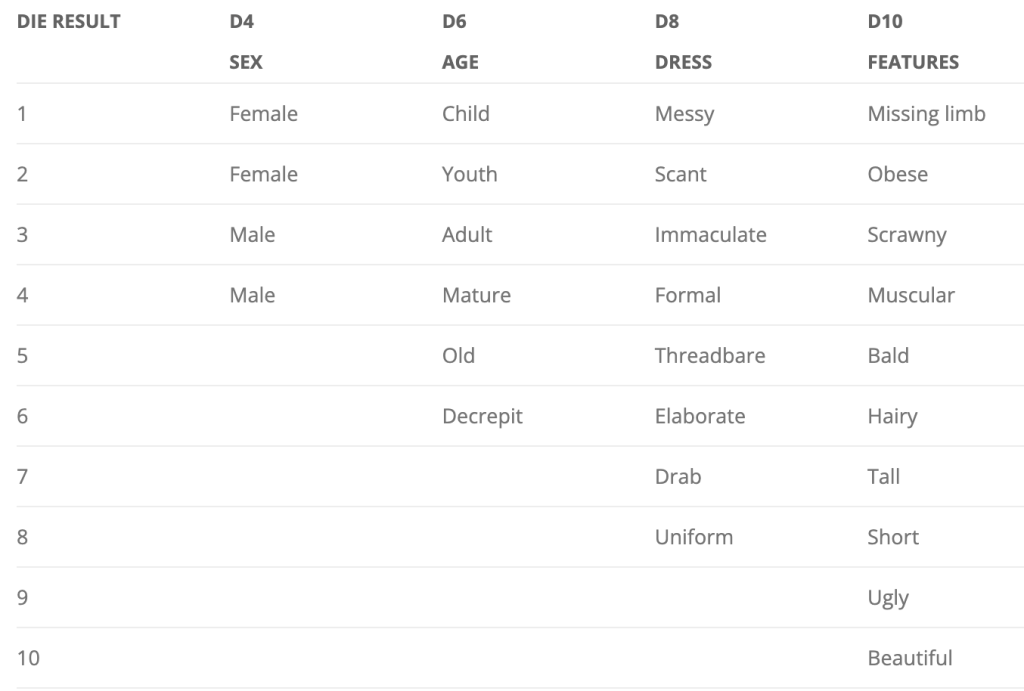
In several of Necropraxis’s posts, he’s using the dice to do other things. For instance, one of his most popular posts is “Overloading the encounter die,” in which he lays out how to use a six-sided die (d6) to determine random encounters while searching a dungeon or traveling in a hex crawl. In another, “Random appearance table,” he uses four dice to quickly create by rolling up NPCs for players to meet and interact with using a group of dice – a d4, d6, d8 and d10. These determine the NPC’s gender, age, dress and features. In the comments section of that post I saw someone suggested using the die type that were not used, a d12 and a d20, to flesh the NPC out further.
That reminded me:
Throwing dice is fun.
Throwing a lot of dice is a lot of fun.
Going further: could you use the dice to make up the game in its entirety by throwing all seven dice? Now, if you’re going to tell me somebody’s already thought of that, somebody’s already done it, no, they haven’t. I haven’t seen it and if I haven’t seen it then this is new.
OK, maybe Matt Finch’s book, Tome of Adventure Design, but who’s got the time for all of that? If you have a better example, I’m kidding; go ahead and tell me so I can study it and get smarter.
And beyond throwing dice, somewhere in my reading over the last year I’ve run across using playing cards as a way to randomly dictate a bunch of information. For example, if you pulled the eight of clubs the suit could be dictating one piece of information, for example a category, and then the eight could be dictating something else like a complication. Now just using a deck of cards along with all your dice, then you have the opportunity to really flesh out the story a lot further.
So, here’s my first stab at some sort of story-building random tables. I’ll consider my Joesky tax paid up for the quarter and I’ll revisit again when I’ve learned and poked at it a bit more.
MY FIRST TABLES
| Die | Category | Purpose |
| d4 | Season/Environment | Establish mood and conditions |
| d6 | Genre | What’s our story type? |
| d8 | Campaign Scale | Determines scope – is this local or galaxy-shaking? |
| d10 | Primary Conflict Type | Beyond genre, what type of story are we telling? Is this about survival? Exploration? Or fanning the seeds of rebellion? |
| d12 | Antagonist/Threat | Who or what is the Big Bad? An ancient monster? A doomsday cult? A rival gang or competing factions? |
| d20 | Adventure Hook/Twist | What’s the catch? |
d4 — Season / Environment
- Spring (renewal, growth, flooding, birth)
- Summer (heat, travel, abundance, light)
- Autumn (harvest, decline, storms, cozy?)
- Winter (scarcity, isolation, survival, darkness)
d6 — Genre (and Touchstones)
- Heroic Fantasy (D&D, Mythic Bastionland)
- Sword & Sorcery (Shadowdark, Pirate Borg, Forbidden Lands)
- Horror (Mothership, Call of Cthulhu, Liminal Horror)
- Mystery (Brindlewood, Vaesen, Cairn)
- Science Fiction (Traveller, Slugblaster, Star Trek)
- Post-Apocalyptic (Fallout, Apocalypse World, Mork Borg)
d8 — Campaign Scale
- Single Village (Tannic)
- Small Town (Deep Lake)
- Major City (Bastion)
- Region (Dolmenwood)
- Kingdom (Gondor)
- Continent (Faerun)
- Planet (Barsoom)
- Multiple Worlds (Spinward Marches)
d10 — Primary Conflict Type
- Political Intrigue
- War
- Exploration
- Survival
- Rebellion
- Investigation
- Treasure Hunt
- Rescue Mission
- Colonization
- Preventing Catastrophe
d12 — Antagonist/Threat
- Tyrant
- Cult
- Ancient Monster
- Criminal Syndicate
- Rival Adventurers or Factions
- Corrupt Government
- Invading Army
- Natural Disaster
- Alien Intelligence
- Rogue AI
- Supernatural Curse
- Betrayer Within
d20 — Adventure Hook / Twist
- A prophecy is wrong
- The villain is actually trying to help
- The party is blamed for a crime
- Time is running out
- A trusted ally disappears
- The threat is growing faster than expected
- The map is incomplete
- Someone is impersonating one or more of the party
- The dead are returning
- The gods have gone silent
- A powerful artifact is broken
- The enemy controls critical resources
- A secret society manipulates events
- The ruler is not human
- Two threats are secretly connected
- The heroes inherit responsibility unexpectedly
- Reality is changing
- A former enemy seeks an alliance
- The true villain is hidden
- The world ends unless the party acts
Other Random Thoughts
In Louisiana, there’s a term, lagniappe (pronounced LAN-yap), that roughly means “a little something extra.” I’ve encountered a random mechanic in a couple of different games over the last few months that I like a lot to increase the tension. We’ll call it imploding encounter die.
In The Dark Crystal game, your character typically rolls a d6 and adds any modifiers to beat whatever hurdle number constitutes success. But if your character takes damage, they can only roll a d4, which makes it harder to meet/beat the hurdle number. If they’re damaged or wounded again, they’re incapacitated. This works well to remind your Gelflings that they need to play smart and not just rush into fights, since they’re smol and fragile as a Mideast peace deal.
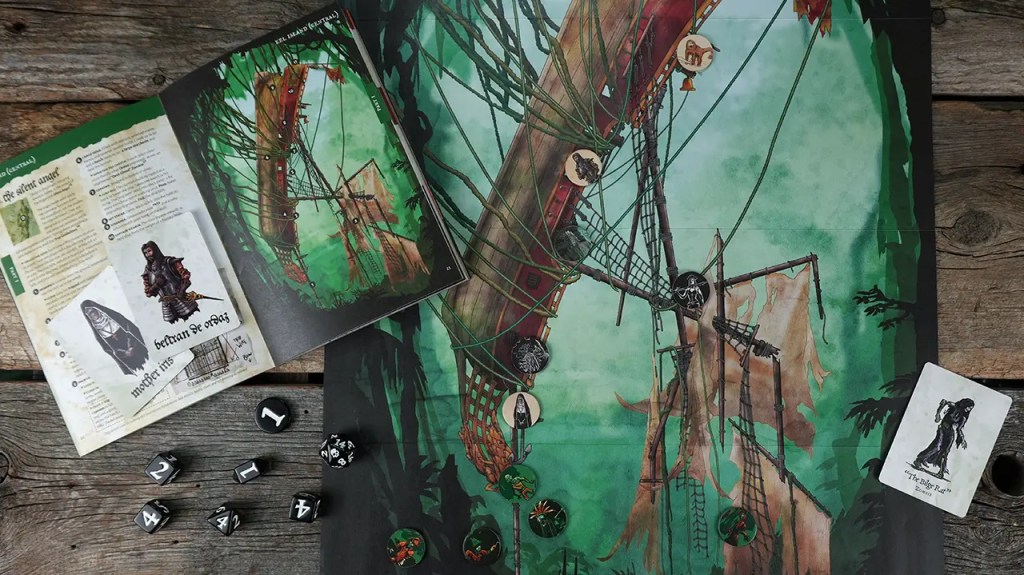
As another example, in the Pirate Borg adventure, Trapped in the Tropics, there’s a scene where the player characters are exploring a ship hanging from vines, stern to bow, in the jungle. Think of a mini vertical dungeon crawl with rewards and surprises throughout the ship. Here, as the players climb through the ship to explore it, they regularly roll a d6. On rolling a 1, the ship shifts and continued exploration means rolling a d4 for stability. On rolling a 1 again, the ship shifts and the risk increases to a d2, meaning they have a 50/50 chance now of the ship falling on their next move and taking fatal damage.
I love the intensity that this introduces and could see using that mechanic again in a lot of other games to keep things moving.
Until next time, keep gathering XP.*

 XP Rolls
Leave a comment