That’s a good thing, friends.
I grew up moving. Alaska, Illinois, St. Croix, St. John, Washington, Florida, Louisiana. But we hailed from the red dirt roads of Tulsa, and every summer we drove back — wherever “back” happened to be launching from that year — to visit Papa, my great-grandfather, and Dad, who was unsurprisingly named Dad.
My grandfather, who raised my brother Brett and me, had to work, so the actual drive was usually a party of four: my grandmother behind the wheel, Brett riding shotgun with the maps, our poodle Beau Beau hanging like a gargoyle over the bench onto the armrest between them, and me alone in the backseat with a stack of books and a window view of America rolling by.
Jesus Christ, you may be saying to yourself, what the fuck does this have to do with games? I’m getting there. Slow your roll or move on to a blog full of sage advice where your time is better spent.
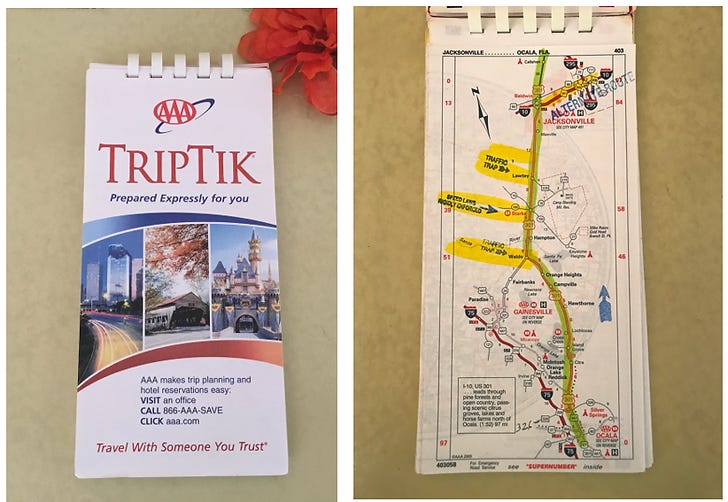
A few weeks before every trip, my grandparents would walk into the local AAA office and engage a real, honest-to-god person like a concierge — the kind of service that’s now been replaced by an app. They’d talk through how far we wanted to drive each day, hotel preferences, fun stops along the way, hopes, dreams, lost loves – it’s hard to say where the planning ended. Then, a week before launch, we’d swing back through and pick up the deliverable: state maps, country maps, regional brochures, and the most important artifact — the TripTik.
The TripTik was a spiral-bound flipbook of small, hand-collated maps that someone in that office had pieced together and run a yellow highlighter down to mark our route. Day one ends here. Day two ends there. Optional side trip to the world’s largest ball of twine if you’ve got the energy and a strong opinion about twine.
This — THIS — is where they shone like Zeus parting the heavens. I mean the whole thing was idiotproof and easy to learn.
What this has to do with dice
I’ve spent the last year falling deep into the TTRPG community, and I’ve noticed something. Hang onto your hat, but people have very strong preferences about how to play these games. Story-first or rules-first. Improvised or scripted. Open-world or guided. And among the players I’ve come to like and respect, there’s a general vibe: telling someone “you’re doing it wrong” is in itself wrong. The better version is “I prefer this style” or “that style isn’t for me.” Different trips, different maps.
Even with that said, the OSR (old-school something or other) corner of the internet veers into the same critique: D&D 5e and Pathfinder 2e are too railroad-y. Meaning no matter what choices the players make, the train still pulls into the same station. Combat resolves, the boss dies, the next chapter begins. The agency is minimal window-dressing vs authentically resonating for a lot of these friends.
Here’s where the TripTik comes in.
5e is my TripTik
When you run a 5e adventure path, what you’re really running is a TripTik adventure. Someone — Wizards of the Coast, a third-party publisher, a dedicated DM with too many free Saturdays — sat down with the equivalent of that AAA concierge and pre-planned the route. The destination is set. The encounters are mapped. The hotels are booked. But within that route, the players still drive the car. They pick the side quests. They decide whether to torch the bandit camp or negotiate with it. On the way to Tulsa, they might take damage from a ferry rolling in a high sea, save someone, screw someone over, find a McGuffin that pays off three sessions later.
Yes, you end up at the same boss fight no matter what. But anyone who’s ever taken a road trip knows: the trip isn’t the destination. It’s what happens in the car and on the road. It’s the diner in Tucumcari. It’s the broken-down car with steam pouring out from under the hood that leads to 3 days in Mattoon. Playing Disco Duck at 3AM at a Waffle House outside Amarillo. It’s the conversation you wouldn’t have had if you’d flown.
The hex crawl is Lewis and Clark (maybe)
The OSR crew seems to prefer a different mode: the hex crawl. This is Lewis and Clark gaming. The map is largely blank — mountains here, a river there, “interior contents TBD.” The players ARE the cartographers. As the party moves into a new hex, the GM rolls on random encounter tables, weather tables, settlement tables, whatever the system or KTrey supplies, and the world reveals itself in real time.
It’s the loosest, most improv-heavy form of play I’ve encountered. Everybody at the table has to be comfortable making shit up —like long-form improv comedy’s “yes-and.” The dice aren’t there to confirm a pre-written outcome; they’re there to surprise the GM as much as the players. When it works and you have the right players, it’s pure exploration. When it doesn’t, it’s four people staring at a hand-drawn hex grid wondering whose turn it is to invent a goblin.
Story games don’t even bring a map
On the far other end of the spectrum, you’ve got story games — Blades in the Dark and its cousins. These barely care about maps at all. The terrain is the relationships. The encounter is what’s happening between the characters in the room. You’re not driving from St. John to Tulsa; you’re trapped in the car with your ex and the fight you’ve been avoiding for six months, and the route doesn’t matter because the destination is the conversation. I feel like this is where one of my new friends uses the word “diegetic” so fit it in there however you think it makes sense.
Three modes. Three different map styles. Three completely valid ways to spend a game night.
The actual point
The trap people fall into — and the reason “you’re doing it wrong” seems to lurk in the background even when unspoken — is assuming the format you prefer is the most authentic version of the hobby.
The OSR purist who thinks 5e isn’t “real” roleplaying is a backpacker mocking someone for booking a hotel. The 5e player who can’t imagine running a session without a battle map and stat blocks is a TripTik tourist who thinks driving without a route (or at least knowing where the speed traps are) is reckless. The Blades fan who rolls their eyes at 5E only wants to ride shotgun with a smoldering gas-soaked rag and a clock counting down, no sweeping vistas required.
None of them are wrong. They’re just on different trips.
If you’re new to TTRPGs, the only useful question is which trip you want to take this weekend.
I honestly love a TripTik — a clear adventure path, the cinematic boss at the end, the comfort of knowing a professional plotted the route.
I also love games like Mythic Bastionland, where I can play Lewis and Clark and find out what’s over the next ridge.
And some weeks I want to sit in the metaphorical car with my friends and be a Guy Ritchie character in a simulated supernatural London.
The point isn’t which mode is best. The point is that the first tabletop roleplaying game I loved probably grew up the same way I did — with good intentions and the freedom to detour when something interesting showed up out the window.*
*Poodle optional.
This post was meant to fit the theme of the Maps-centric blogwagon. Mostly a good excuse to think about games and trips.

 XP Rolls
Leave a comment